Soldering Station for Electronics Repair: A UK Bench Guide
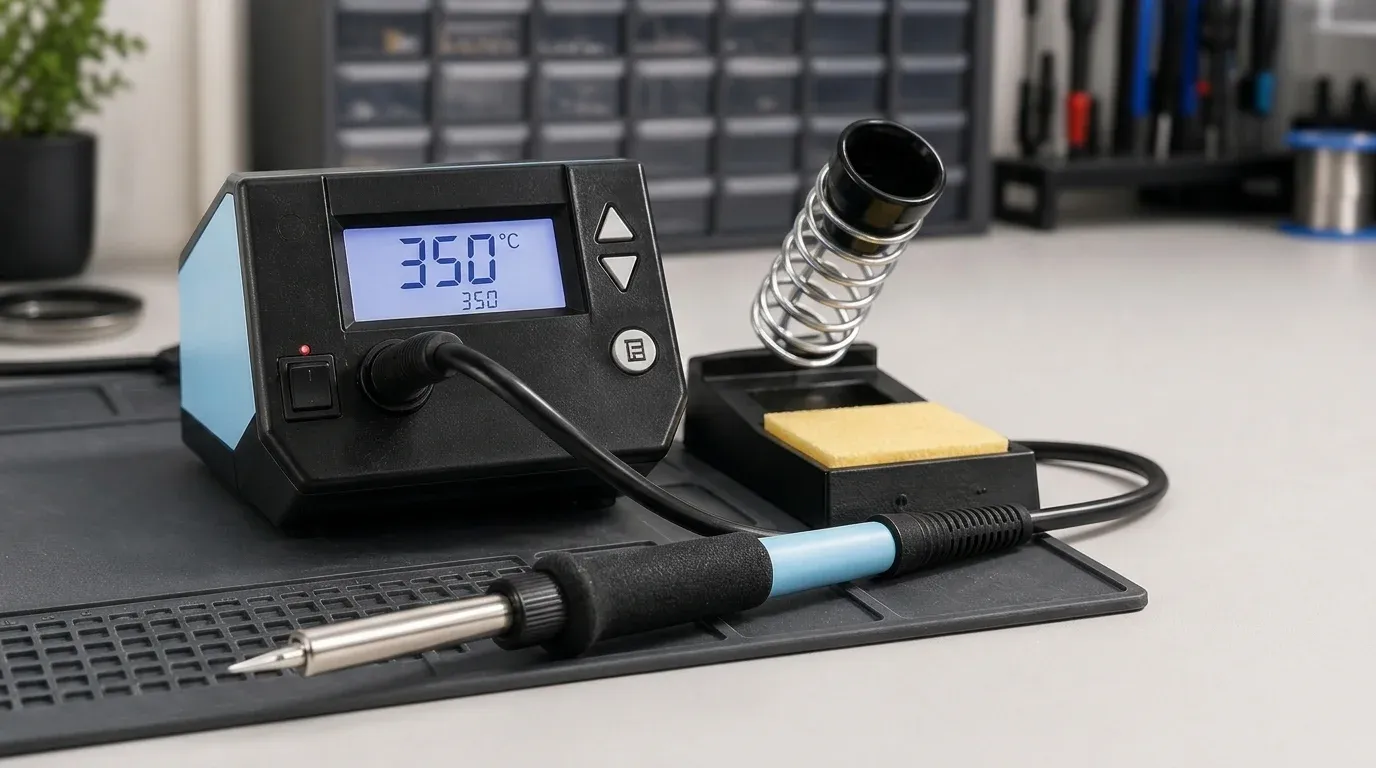
A technician repairing PCBs and motherboards every day has a different risk from an occasional maker: an unreliable tool can turn one awkward joint into repeat work and stop the bench taking the next job. Start with the repairs that cause delays, then choose the handpiece, tip system and process that address those joints.
Start with the joints on the repair bench
A station is a controlled power unit and handpiece, not a guarantee of a good joint. Small exposed pads, through-hole leads, wire terminals and connectors each transfer heat differently. A large copper area can draw heat away from the tip while a fine pad can be damaged by too much contact area or dwell.
| Recurring job | What to verify | Honest boundary |
|---|---|---|
| Fine PCB pad or connector pin | A tip that reaches the joint without touching neighbours, stable support and good visibility | A needle-like tip is not automatically better if it cannot transfer enough heat. |
| Through-hole joint or wire terminal | Useful tip contact area and recovery after the joint absorbs heat | Do not compensate for poor contact by guessing a much higher setting. |
| Large ground connection | Tip geometry, thermal load and the documented process | A wattage label alone cannot predict the result on every board. |
| Hidden-pad or multi-pin removal | The complete rework method, often including controlled hot air or preheating | An iron-only station may be the wrong tool; use the motherboard repair tool guide. |
Read power and temperature specifications precisely
Manufacturer terminology matters. Weller lists the UK set with item number T0053298399 as a 230 V, 85 W digital power unit supplied with a WEP70 70 W iron and PH70 safety rest. The official range is 100–450°C and the handpiece uses ET tips. Calling the whole set simply a “70 W station” loses the distinction between power-unit input and iron rating.
Weller also publishes an approximate 28-second heat-up from 50°C to 350°C. That is a stated test condition, not proof of recovery on a particular multi-layer board. A professional repair technician should still assess the tip, joint mass, solder, board condition and dwell rather than turning one catalogue number into a universal performance promise.
Make the tip system part of the purchase decision
A station that sits idle for want of the right tip does not reduce downtime. Check the exact handpiece and compatible tip family before ordering, then confirm that the shapes used on the bench are realistically available. For the WE1010 UK set, the maker specifies ET tips and lists a 1.6 mm chisel in the scope of delivery.
Tip care affects heat transfer as well. Weller advises cleaning with brass wool or an appropriate damp sponge and tinning before and after use. Its guidance favours dry cleaning after high-temperature work because a wet sponge can cause thermal shock. Replace a damaged tip; do not file through its plated surface.
A model-specific buying checklist
- Match the exact item number, mains voltage, handpiece, rest and included tip across the listing, manual and packaging.
- Confirm the tip family and the shapes needed for the bench, not merely the number of accessories in the box.
- Check whether settings can be locked if several technicians share the station, while keeping a written process for each job.
- Ask for the current conformity and supplier documentation that applies to the exact model. GOV.UK currently recognises CE or UKCA for applicable electrical equipment in Great Britain; a logo alone is not the whole check.
- Separate the iron purchase from extraction, lighting, magnification and any hot-air requirement.
The current WeSolde listing shows £517.05. Treat that as a live listing price to recheck, not evidence that the station is economical for every bench. Compare it with the cost of the tips and support you will actually use and the downtime caused by the present tool.
ESD and fume controls remain separate systems
Weller describes the WE1010 set as ESD safe, but that does not make the entire workspace an ESD protected area. The EOS/ESD Association describes a wrist strap as one part of a system with a suitable common point and regular testing. It also says a wrist strap must not be used where the operator is exposed to circuits of 250 V or higher. Isolate power and stored energy before board work and follow the equipment's service information.
The HSE identifies rosin-based solder flux fume as a top cause of occupational asthma. Its practical controls include avoiding overheating, using fume extraction, keeping the head out of the plume and maintaining the extraction system. A small fan that merely moves the plume across the bench is not proof of effective capture.
Frequently asked questions
Is a 70 W iron enough for electronics repair?
It can cover many bench tasks, but the answer depends on tip contact, joint mass, board construction and process. Weller's UK WE1010 set uses a 70 W WEP70 iron with an 85 W power unit; neither number guarantees every repair.
What temperature should a soldering station use for PCB repair?
There is no universal setting. Use the solder, component and service information, then the lowest effective process for the joint. Tip geometry and dwell matter alongside the displayed temperature.
Does an ESD-safe soldering station remove the need for ESD controls?
No. The station is one item. The board, work surface, grounding or bonding method, wrist strap where appropriate, handling and verification still need a defined ESD-control process.
What does the current WeSolde WE1010 listing cost?
The live listing showed £517.05 when this guide was checked on 20 July 2026. Recheck the listing and exact item number before ordering; this guide does not claim that the price is a discount or the right value for every bench.
Sources and scope
Sources checked on 20 July 2026. Manufacturer specifications, regulations and product listings can change; verify the current document and exact item before acting.
Review the current WeSolde listing
View the WE1010 listing — £517.05